How to Finance an ADU in Tampa Bay
Key Takeaways
- Getting familiarized with Tampa’s specific zoning laws and legal requirements is crucial before you start planning your ADU project and financing.
- Tampa homeowners can utilize many different financing options. These forms of financing consist of home equity loans, cash-out refinancing, construction loans, renovation loans, personal loans, and reverse mortgages for seniors.
- Many local, state, and federal grants and incentives are available to reduce the cost of constructing an ADU in the Tampa Bay metropolitan area. Be sure to stay on top of eligibility requirements and deadlines to make the most of these opportunities!
- Tampa lenders will usually look at your credit score, income, and other financial documents. Keeping your financial documents in order and creating a healthy financial picture is key!
- Diligently shop loan quotes, interest rates, and payback periods. Consider lenders fees when shopping for the best financing available for your ADU!
- An ADU can increase your property value, create new rental income opportunities, and may impact your property taxes and insurance needs, so plan ahead for long-term financial effects.
What’s an ADU in Tampa?
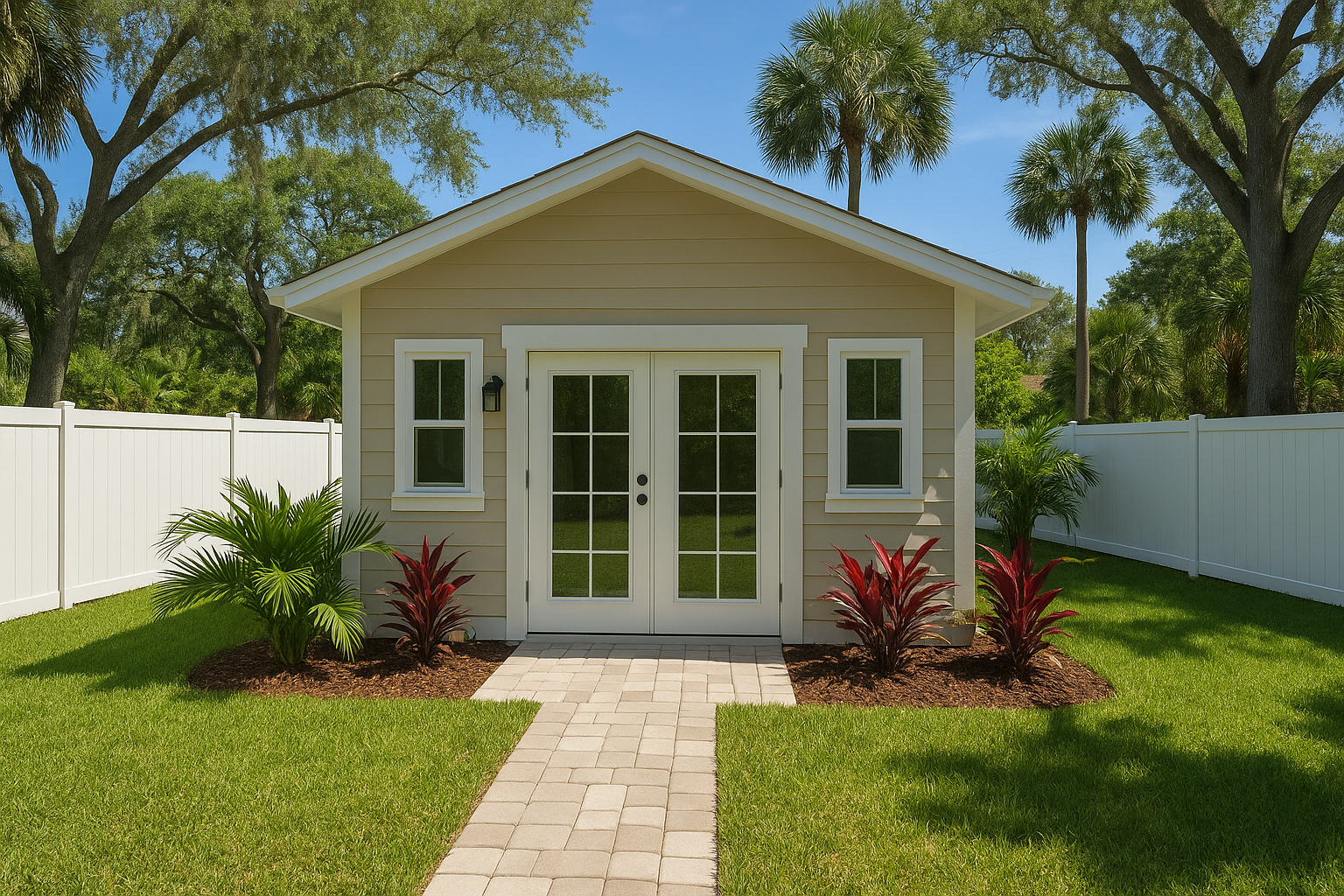
Accessory dwelling units, or ADUs, are independent residential units located on the same lot as a single-family home. In Tampa, these units usually come in the form of a granny flat, a cottage, or an in-law suite.
Tampa’s Land Development Regulations provide specific and reasonable criteria that allow for ADUs to be developed. They define which areas ADUs can be located in and what designs are permitted. An ADU may need to be no less than 10 feet away from the primary residence, for example.
It has to be a minimum of 350 square feet, but no larger than 75% of the primary residence. If your ADU is larger than 500 square feet, the city requests an additional parking space.
Defining Accessory Dwelling Units
What makes an ADU unique is that it has its own kitchen, bathroom, and sleeping quarters. It lives on the same parcel as a much larger single-family home.
Different from duplexes or condos, ADUs remain attached to the primary residence and can’t be sold off on their own. In Tampa, the legal standard is clear: these units must meet set size, setback, and design rules so they blend into the neighborhood.
Tampa’s Unique ADU Landscape
All around Tampa Bay, ADU construction is booming. Currently, homeowners often build them for aging parents, adult children, or even as rentals.
Many are attracted by the city’s permissive regulations, such as the exclusion of ADUs from the standard density caps. This allows owners to add a new unit more easily without facing zoning hurdles.
Why ADUs Boom in Tampa Bay
With a massive need for affordable homes across Tampa Bay, ADUs provide a great option. They provide property owners with an opportunity to generate rental income or better accommodate family members, all while maintaining the character of traditional single-family neighborhoods.
These elegantly sustainable units increase affordable housing options and strengthen community connections.
Your Tampa ADU Financing Toolkit
Financing an Accessory Dwelling Unit (ADU) in Tampa It’s About More than Choosing the Right Loan You should have a clear idea of your budget, the value of your home, and which lenders are familiar with the local market.
With quality ADU projects in Tampa Bay typically running $175,000 to $350,000 all-in, financing an ADU can be a significant strain on your finances. Most Tampa homeowners pay cash, pull from savings or rely on family for support.
With the right tools and attitude, you can make your money work in your favor. In the process, you’ll find a savvy approach for producing that additional room. Below, you’ll find a kit tailored to Tampa’s unique needs.
It walks you through your financing options, clarifying what each option entails and guiding you in evaluating their advantages and disadvantages.
| Financing Option | Typical Requirements | Pros | Cons | Local Fit |
|---|---|---|---|---|
| Home Equity Loan/HELOC | 15-20% equity, 620+ credit score | Flexible, lower rates | Risk of foreclosure | Widely available |
| Cash-Out Refinance | Good credit, home equity | Large lump sum, fixed rates | Closing costs, resets loan | Common in Tampa |
| Construction Loan | Builder contract, strong credit | Tailored for ADUs, phased pay | More paperwork, short term | Regional banks |
| FHA 203k/Homestyle | 620+ score, owner-occupied | Low down payment, covers reno | Strict rules, fees | Less common |
| Personal Loan | Good-excellent credit | Fast, no collateral | Higher rates, small sums | Online lenders |
| Portfolio/Bridge Loan | Asset-based, local lender | Flexible, fast approval | Higher rates, short term | Tampa specialists |
| Reverse Mortgage | 62+, primary residence | No payments, tap equity | Reduces inheritance | Seniors in Tampa |
1. Leverage Home Equity: Loans & HELOCs
Most Tampa homeowners seeking to finance an ADU will look to their home’s equity.
- Home Equity Loan or Home Equity Line of Credit (HELOC) An equity loan or HELOC allows you to borrow money based on the equity in your home. If you’ve paid off at least 15-20% of your mortgage already, you’re in good shape!
If your credit score is in the mid-600s or better, you should have no problem meeting lender requirements. HELOCs offer a line of credit that acts like a credit card.
You only pay interest on what you withdraw, which makes them great for staggered construction costs. Home equity loans provide a lump sum, useful for upfront expenses.
The biggest advantage is lower interest rates than personal loans. Your house is at stake if you default on repayments. First, put together a list of the ADU essentials.
From there, account for a buffer for cost overruns to determine how much you should borrow. Avoid using your line of credit to the max—maintain some space for emergency home repairs or other costs.
2. Unlock Value: Cash-Out Refinancing
Cash-out refinancing Simply put, a cash-out refinance involves replacing your current mortgage with a new, larger one and keeping the remaining funds.
This approach is best if Tampa home values have appreciated since your original purchase. You pay off your existing loan and receive cash to put toward your ADU.
Closing costs and a new mortgage term are big trade-offs. If the market conditions have changed, you may be able to lock in a better rate!
To determine how much you qualify for, start by subtracting your existing mortgage from your home’s appraised value. Then take that figure and multiply it by roughly 80%, because lenders almost never let you cash out the full difference.
Those looking to settle in one place for decades tend to prefer this option. It locks their loan into a fixed rate and releases scores of capital. If you’re nearing the end of your mortgage, this option won’t work well for you.
If rates have risen, you need to explore alternatives.
3. Build New: ADU Construction Loans
Regular construction loans cover new builds, including ADUs. These loans disburse in phases as work completes, providing additional supervision and spending control.
Local expertise and competitive terms Tampa banks or credit unions might be able to provide local expertise and competitive local terms.
You will have to have a licensed builder, a comprehensive budget, and architectural plans ready. Proof that you can pay it back Lenders will usually require proof that you can repay the loan, including proof of income and good to excellent credit.
You’ll get a shorter term and higher rates than a normal mortgage. The money will keep up with your project! Once construction is complete, you typically refinance into a traditional mortgage.
4. Renovate Smart: FHA 203k & Homestyle
If you’re adding an ADU to an older Tampa home, FHA 203k or Fannie Mae’s Homestyle loans could cover your costs. Both allow you to roll renovation costs into your primary mortgage.
You must be an owner-occupant of the property and have a minimum credit score of 620. These loans can finance extensive projects, ranging from gut rehabs to smaller renovations that bring a unit up to local code.
The major attraction is the lower down payment and that you can roll all of your costs into one loan. Regulations are often rigid and costly, and fees quickly accumulate.
Not all Tampa lenders will underwrite these, so look for lenders that understand FHA and Homestyle programs.
5. Consider Personal Loans for ADUs
Personal loans provide you with fast money with no collateral required. These are most effective for smaller ADUs or when all else fails.
As with any loan, you’ll need a good credit score to receive favorable interest rates. The biggest advantage is urgency—most lenders can approve and fund in a matter of days.
Rates are higher, and loan limits can’t cover a full ADU build. Look for the fine print on fees, prepayment penalties, and total interest cost before proceeding.
6. Tampa Lenders: Portfolio & Bridge Options
Portfolio lenders are local community banks and credit unions who hold loans in-house. They will be more flexible on ADU loans — these can be key if you don’t meet very rigid guidelines set by other lenders.
Bridge loans offer quick lump sums to bridge the gap, such as building an ADU while selling your previous property. While rates are higher, the speed of approval is immediate.
Tampa’s lending scene is expansive, so be sure to shop around and compare offers. Understanding your market can translate to better loan terms and less overall headache.
7. Seniors: Explore Reverse Mortgages (HECM)
For Tampa homeowners aged 62 and up, a reverse mortgage, or Home Equity Conversion Mortgage (HECM), lets you tap home equity with no monthly payments.
This can help pay for an ADU for aging in place or generating extra income. You need to occupy the property and stay current on property taxes and homeowners insurance.
The only real trade-off here is that your heirs will receive less. Even so, for those who need it, this is an opportunity to age in place and increase property value and home flexibility.
Tampa Bay ADU Grants & Incentives
Financing your accessory dwelling unit (ADU) in Tampa Bay requires more than a solid blueprint. It urges more research into programs at the local, state and federal levels that can reduce costs or facilitate financing. Tampa allows ADUs by permit within certain neighborhoods.
Yet these rules are inconsistent, so always check with your local city or county planning offices before you start doing anything! Some areas in Hillsborough County cap ADU size at 900 square feet, or up to 1,200 square feet with a variance. Minimum lot size and setbacks are other factors that can be an issue.
Here’s a quick look at common grants and incentives you might find:
- Local city or county ADU grants (when funded)
- State-level ADU funding aid (subject to availability)
- Federal home renovation and energy efficiency programs
- Time-limited incentives for affordable or fair market rentals
Local Tampa ADU Financial Perks
Tampa sometimes offers local incentives for ADU builders, like permit fee waivers or fast-track approval, which can save time and money. Additionally, certain neighborhoods could be eligible for additional assistance.
This is true only provided that the ADU is rented at fair market rates for a minimum of five years. However, a number of these perks depend on city operating budgets or specific grants/initiatives. Deadlines sneak up on you fast.
Local grant programs in Florida ran out of $25 million in just three days in early 2024.
Federal Programs for ADU Builders
Federal alternatives, such as FHA 203(k) loans or Freddie Mac’s CHOICERenovation, allow homeowners to incorporate ADU expenses into their primary mortgage. These loans often have lower interest rates than personal loans.
The process involves costly home appraisals, burdensome documentation, and caps related to the principal value of the property. In many cases, this path literally provided access where local money was insufficient.
Secure Your Tampa ADU Loan
It does require a bit of legwork upfront. Homeowners typically must have 15–20% equity, a credit score in the mid-600s or above, and a debt-to-income ratio under 50%.
So, the process begins with creating ADU blueprints, obtaining necessary permits, and then turning to a lender. Here’s how to move forward:
- Obtain ADU plans from TomCo Solutions who is familiar with Tampa’s codes.
- Apply for permits through the City of Tampa.
- Reach out to potential lenders, present your project plans, and begin the ADU loan application process.
- Collect required documentation, including pay stubs, W-2s, mortgage statements, and insurance declarations.
- Review loan offers, checking rates and terms.
- Select a loan, execute, and proceed to appraisal and approval.
Lender Criteria: What Tampa Banks Seek
Equity, credit and income are crucial factors. All lenders in Tampa will look for equity, credit and income. They’ll expect a credit score of at least 660, consistent employment history, and a strong debt-to-income ratio.
A clean and robust financial profile will only increase your chances at obtaining the best possible rates and higher likelihood of approval.
Gather ADU Loan Documents
You’ll have to compile pay stubs, tax returns, proof of insurance, and mortgage information. Thorough, well-prepared paperwork makes you look efficient and professional—lacking or incomplete documentation will only drag out the process.
If you keep digital records, have them all stored in one location for fast access.
Compare ADU Loan Offers Effectively
Consider interest rates, repayment term (typically 25–30 years), associated fees and closing costs.
Cash-out refinance vs HELOC: Cash-out refinance and HELOCs each have their advantages and disadvantages. Inquire whether there are prepayment penalties, or if the rate will change, as ADU loan rates are subject to change.
Navigate ADU Appraisal & Approval
Your property, including the existing home and new ADU, will be appraised by lenders to determine the loan value. Prepare for site visits and be prepared to answer questions about your plans.
Providing clear, detailed plans will get you through the process much more easily.
Manage Construction Draw Schedules
Loans are typically disbursed in increments. Coordinate with your lender and contractor to schedule draws.
Monitor expenditures to help ensure your project stays within budget and minimize the risk of construction payment lags.
ADU’s Impact on Tampa Property Finances
It’s not just an upgrade Adding an Accessory Dwelling Unit (ADU) in Tampa. It’s a huge influence on their long-term bottom line as property owners! Local regulations have opened the door for ADUs on multi-family lots, and approvals are received within 60 days.
This change creates exciting opportunities for homeowners who want to increase their property value and develop additional income streams.
| Financial Benefit | Description | Example/Range |
|---|---|---|
| Property Value Boost | 20–30% increase, up to 35% higher sales price | $400,000 home + 30% = $520,000 |
| Rental Income | Monthly rent for ADU, offsets costs | $1,900–$2,300 per month |
| ROI | Long-term value through rent and appreciation | 5–10% annual return possible |
| Affordability Impact | More housing options for middle-income families | 23% listings affordable; ADUs help fill gap |
Boost Property Value with an ADU
On average, ADUs increase a home’s value by 20–30%, with one-third of homes listed at 35% more because of an ADU. Tampa’s housing market trends further emphasize demand for adaptable living arrangements.
Thanks to the addition of an ADU, this South Tampa property is now $100,000 richer. As a result, purchase price increased from $400,000 to $540,000 in just two years!
Tampa Property Taxes & Your ADU
What to Expect on Tampa Property Taxes When Adding an ADU Homeowners must review local regulations, since tax rates are a factor of the increased value and usage of the property.
Post Build Maintain Documentation Before building, maintain documentation through the process and discuss with a local tax adviser to prepare for any property tax increase.
Insuring Your New Tampa ADU
Your new ADU will require robust insurance. Homeowners will need to purchase coverage for the new structure, contents, and liability.
Consult local agents to customize policies whether the ADU is rented or used by family.
ADU Rental Income: A Financial Plus?
Renting an ADU in Tampa provides an owner $1,900 to $2,300 a month. This additional income can cover a substantial chunk of the large costs associated with such projects, which typically total between $175,000 and $350,000.
Good tenants and smart management go a long way toward ensuring stable returns.
Conclusion
Whether you’re looking to increase the value of your home, add some additional space, or earn some rental income, building an ADU in Tampa is a great option. Local lenders in Tampa, provide loans specifically tailored for ADUs. If local jurisdictions offer grants, they can significantly reduce the upfront costs. Unlike homeowners using HELOCs or cash-out refis, new ADU loans are targeted at ADUs specifically. Each one operates slightly differently, so consider the benefits and drawbacks for your situation. Having accurate information in advance and good planning will keep your budget on track and save you a lot of heartache. People who engage with their local lenders or city offices have more success in locating the best deal and experiencing the least amount of disruption. Finally, remember that once you have your financing in place, you will need a trusted ADU builder in Tampa like TomCo Solutions to get the project off the ground.
Frequently Asked Questions
What is an ADU in Tampa?
What’s an ADU in Tampa? An ADU, or Accessory Dwelling Unit, is a small, self-contained home that you can build on your existing property in Tampa. It could be a backyard cottage, garage apartment over a parking pad, or an in-law suite, offering various financing options for homeowners.
What are the main ways to finance an ADU in Tampa?
Home equity loans, cash-out refinancing, and construction loans are popular loan options, while other Tampa banks and credit unions may offer specialized ADU financing options.
Are there any ADU grants or incentives in Tampa Bay?
Are there any ADU financing options, grants, or incentives in Tampa Bay? Contact the City of Tampa and Hillsborough County to inquire about existing financing programs.
Can I use rental income from my ADU to help qualify for a loan?
In Tampa, many lenders consider future rental income from your ADU when applying for construction financing. Contact your lending provider to learn about their specific loan options and guidelines.
How does building an ADU affect my Tampa property taxes?
As with any improvement, building an ADU will likely raise your property value and subsequently your property taxes. Contact the Hillsborough County Property Appraiser for further clarification.
What is the average cost to build an ADU in Tampa?
On average, Tampa residents can expect quality ADU projects to run between $175,000 and $350,000 all-in—again, largely depending on the size, materials, and finishes chosen for the project.
Do I need special permits to build an ADU in Tampa?
Check with the City of Tampa Building Department for help navigating the financing process.
Leave a Reply